If you have ever found yourself standing in the kitchen at 8:00 AM, clutching a lukewarm cup of coffee while pleading with your child to put on their second shoe for the seventh time, you are not alone. In fact, science confirms what millions of parents feel intuitively every morning: the school morning rush is the single most stressful window of the entire week.
While evening bedtime routines get plenty of attention, developmental psychologists and stress researchers have found that morning transitions trigger a unique psychological and physiological storm in family households. Below, we examine the landmark research behind morning panic and explore science-backed strategies to bring lasting calm to your home.

1. Morning Stress Peaks: Cortisol and Loss of Agency
Survey data mapping daily stress levels hour-by-hour suggests that early morning pressure reaches a sharp climax for most adults:
"7:23 AM is the average peak moment for daily stress, with many people encountering their first stressful event before 8:00 AM" (OnePoll & Rescue Remedy, 2023).
Beyond consumer survey data, physiological research confirms this acute morning spike. In a study examining working mothers, researchers found that combining parenting demands with workday pressure significantly elevated morning cortisol levels and altered the Cortisol Awakening Response (CAR) via the hypothalamic-pituitary-adrenal (HPA) axis (Hibel et al., 2012).
Why do early mornings hit so much harder than evenings?
- Fixed, Unyielding Deadlines: Unlike evening routines where bedtime can flex by 15 minutes without immediate consequences, morning deadlines are binary. School bells chime at an exact minute, and work start times are rigid.
- Perceived Loss of Agency: When a child dawdles over breakfast or misplaces a backpack, parents experience a cognitive state known as perceived loss of agency—the stressful realization that an inevitable negative outcome (being late) is approaching rapidly without an easy mechanism to accelerate the process.
2. The Neuroscience of Child "Time Blindness"
Parents often assume that issuing a warning like "We have to leave in 5 minutes!" provides a clear, actionable signal. However, developmental cognitive neuroscience reveals why this approach repeatedly fails.
A child’s capacity to track time, plan ahead, and regulate behavior depends on executive functioning—a suite of cognitive processes mediated by the prefrontal cortex (Best & Miller, 2010). Because the prefrontal cortex undergoes a remarkably protracted maturation process extending into early adulthood, young children experience environment-driven "time blindness."

Key Cognitive Realities for Children Under 9:
- Abstract Temporal Incompetence: Terms like "10 minutes" or "hurry up" carry minimal cognitive weight for young children, whose perception of time is dominated by immediate sensory and emotional stimuli rather than clock intervals.
- High Cognitive Switching Costs: Moving from an engaging activity (like playing with a toy) to an operational task (like brushing teeth) requires significant inhibitory control and task-shifting capability—functions that are still primitive in early childhood (Best & Miller, 2010).
Developmental Insight: Why Children Dawdle
Children aren't being stubborn when they move slowly like Sam the Sloth—their brains simply process time as a sequence of events rather than a ticking clock.
3. Parental Decision Fatigue and Auditory Friction
By 8:00 AM, the average parent has already issued between 20 and 40 micro-directives: "Eat your toast," "Grab your backpack," "Where are your socks?", "Don't touch your sibling."
This constant stream of verbal instruction creates two damaging feedback loops:
- Auditory Habituation: When children are continuously bombarded with verbal commands, their sensory filtration systems adapt. The parental voice transitions from an active instruction signal into ambient background noise.
- Decision Fatigue: Every micro-directive drains working memory and mental energy reserves before the workday even begins, leaving parents vulnerable to emotional exhaustion and reactive yelling.
4. The Solution: Shifting to Visual Pacing and External Anchors
How do we break this cycle? Pediatric behavioral specialists and intervention researchers recommend shifting from verbal nagging to objective visual systems.
Research demonstrates that Visual Activity Schedules (VAS) serve as antecedent environmental cues that lower working-memory burdens, decrease transition delays, and foster independent task execution without constant verbal prompting (Hume et al., 2014; Knight et al., 2015; Meadan et al., 2011).
When a routine is visual, linear, and standardized, the burden of enforcement shifts away from the parent and onto a neutral external anchor. The parent stops acting as the "nagging warden" and becomes a supportive coach.

Empowerment Over Directives
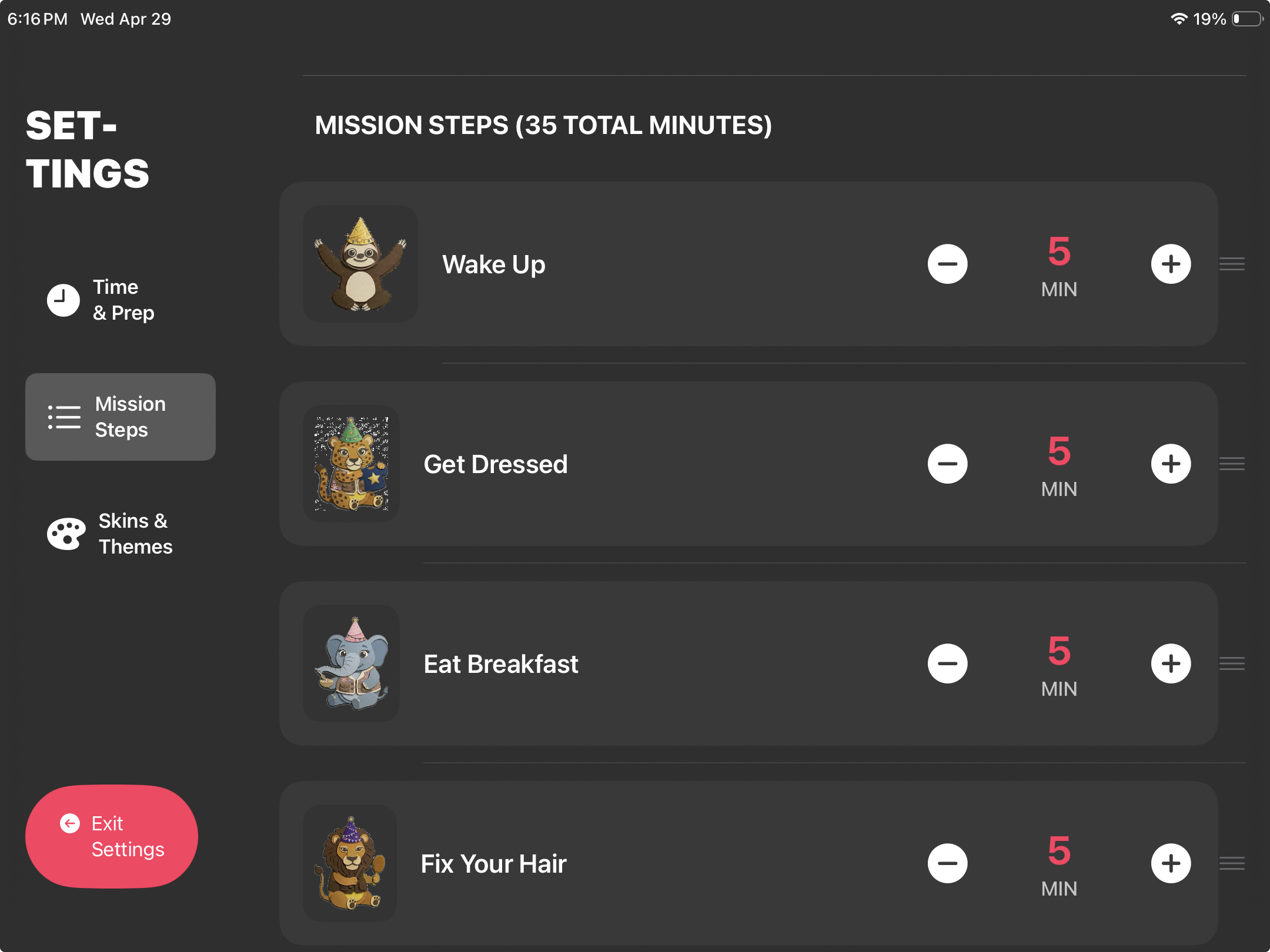
When kids can see their progress—like moving from Austin the Lion at doing hair to Zoe the Zebra putting on shoes—they gain a sense of autonomy and pride.
3 Steps to Implement Tomorrow Morning:
- Externalize the Schedule Visually: Replace verbal reminders with physical visual schedules (using icons, photos, or digital visual timers) placed at eye level where the child can track progress independently.
- Use Spatial Stations Over Clock Times: Anchor tasks to physical locations or visual checkpoints in the home (e.g., "Station 1: Bathroom," "Station 2: Breakfast Table," "Station 3: Shoe Cubby") rather than abstract clock times.
- Lock in Fixed Task Sequences: Maintain an identical task order every single morning. Consistent sequencing strengthens neural pathways, transforming conscious cognitive effort into automatic habit loops over time.
References & Peer-Reviewed Literature:
- Best, J. R., & Miller, P. H. (2010). A developmental perspective on executive function. Child Development, 81(6), 1641–1660. https://doi.org/10.1111/j.1467-8624.2010.01499.x
- Hibel, L. C., Mercado, E., & Trumbell, J. M. (2012). Parenting stressors and morning cortisol in a sample of working mothers. Journal of Family Psychology, 26(5), 738–746. https://doi.org/10.1037/a0029340
- Hume, K., Loftin, R., & Lantz, J. (2014). Increasing independence in autism spectrum disorders: A review of three focused intervention practices. Journal of Autism and Developmental Disorders, 45(1), 157–178. https://doi.org/10.1007/s10803-014-2201-z
- Knight, V. F., Sartini, E., & Spriggs, A. D. (2015). Evaluating visual activity schedules as evidence-based practice for individuals with autism spectrum disorders. Journal of Autism and Developmental Disorders, 45(1), 157–178. https://doi.org/10.1007/s10803-014-2201-z
- Meadan, H., Ostrosky, M. M., Triplett, B., Michna, A., & Fettig, A. (2011). Using visual supports with young children with challenging behaviors. Beyond Behavior, 20(2), 28–35.
- OnePoll, & Rescue Remedy. (2023, February). The daily stress report: Identifying peak daily stressors. SWNS Media Group. https://swnsdigital.com
Transform School Mornings with The Morning Map
Put an end to morning stress. The Morning Map turns morning routines into an engaging, visual trek led by Toucan Tommy—giving your kids independence and restoring peace to your home.
Available on Apple (iOS & Apple TV) • Roku • Expanding to Amazon Fire TV & Android TV